ESG in practice: Securex and ZOUTMAN share their experience

Any organisation that wants to embed sustainability into its operations faces two major challenges. First: how do you bridge the gap between ambition and tangible results? Second: how do you avoid sustainability becoming a separate, stand-alone track? Pantarein has developed a method to integrate ESG step by step and address both challenges. In this Insight, our clients Securex and ZOUTMAN explain that approach from their perspective, respectively in the service sector and the food industry.

October 27, 2025
No items found.

Ine Heyerick is Sustainability Specialist at Securex, the service provider that supports companies and self-employed professionals in the fields of HR, welfare, payroll administration, and entrepreneurship, with 1,900 employees across 30 offices in 5 countries. Maarten Delbaere is Sustainability Manager at ZOUTMAN, a food company based in Roeselare with 140 employees that refines up to 450,000 tonnes of high-quality sea salt each year and ships it to more than 60 countries. Together with them, we will walk through five pillars of an integrated ESG policy. The sixth pillar, data collection and reporting, will be addressed in a subsequent Insight

Establishing a structure and governance

A solid structure makes the difference between isolated initiatives and an integrated sustainability policy. Governance is about who is responsible, how decisions are made, and how ESG is embedded in management.

Maarten, what does ZOUTMAN's ESG framework look like?

Maarten: "We deliberately kept it simple and workable. Not too many new structures or meetings – we don't want to overburden our people – but allowing ESG to grow within our existing operations. We set up an ESG steering committee and created seven tracks concerning topics such as operations, employees, and packaging. Each of those seven tracks is monitored by a working group."

"As Sustainability Manager, I act as the bridge builder: I attend all working groups and report to the steering committee, of which our CEO is also a member. He, in turn, keeps the board of directors up to date. In addition, ESG is on the agenda of the management team every quarter, where the focus lies on updating and inspirating."

Securex has taken a different approach, Ine, without a formal ESG committee but with one central ESG lead: Ruth Broekaert, the company’s Sustainability Director.

Ine: "Ruth holds a cross-functional role: she reports directly to the CEO, provides quarterly updates to the executive committee, and delivers an annual report to the works council and the board of directors. We work with three tracks, each followed up by a working group. Two cross-functional working groups focus respectively on targets and KPI reporting. The third, thematic working group revolves around climate, and more specifically our carbon footprint."

Developing an ESG strategy and roadmap

Everything starts with a clear ESG strategy. The double materiality assessment (DMA) helps to draw up a roadmap that provides direction and guidance for all actions. For many companies, the DMA will no longer be mandatory in the future, but ZOUTMAN continues to recognize its value.

Maarten: "We would have carried out the DMA even without an obligation. When you directly engage your internal and external stakeholders, your impacts and priorities become much clearer. It creates focus. If you only ask yourself, 'What is important to us?', you risk overlooking themes."

"Pantarein advised us to conduct a new DMA every four years, and that makes sense to us: priorities shift, new stakeholders emerge, and we ourselves build up knowledge. That way, you keep your finger on the pulse."

“ZOUTMAN has built a roadmap towards 2030 around the three classic pillars: environment, social, and governance. For us as a manufacturing company, environment is the most substantial pillar, with ambitions relating to production, packaging, and logistics. By 2030, we want to reduce our scope 1 and 2 emissions by 20 per cent and our scope 3 emissions by 5 per cent.”

Climate is also part of Securex’s roadmap, Ine, but there’s a strong focus on the social dimension as well.

Ine: "As a service provider, our internal and external focus is indeed on people, with actions around working conditions and supporting our clients. Our roadmap towards 2030 has two pillars: 'Empowering our people' and 'Driving sustainable impact'. Engaging colleagues in climate action is more challenging, because as a service company that topic is less tangible for us than it is for a company like ZOUTMAN – but that doesn't make it any less important."

Developing action plans

Maarten, by 2030, ZOUTMAN aims to achieve the gold rating from EcoVadis, the global platform that assesses companies’ sustainability performance. How have you embedded that trajectory into your operations?

Maarten: "By bundling all actions into a single plan per for each objective. The actions are monitored by our seven ESG working groups, again with me acting as the linking pin."

Ine: "At Securex, each objective has an owner who develops an action plan. Because we combine low staff turnover with a high average length of service, for example, we want to increase the number of training hours followed. The target owner discusses this with the colleagues involved: how can we best approach this objective? That way, you create buy-in and a willingness to take action in one fell swoop."

Working on internal engagement

Putting ESG into practice is impossible without your colleagues. Maarten, how do you, as a sustainability manager, bring – and keep – people from different departments on board?

Maarten: "Again, through my role as a mediator. Since becoming Sustainability manager, I spend a lot of time talking to my colleagues. I visit all departments, explain how ESG works and why we need certain information. Feedback is important: when we achieve a success, I explicitly thank people for their contribution."

Ine: "Internal activation is incredibly important, for instance when collecting ESG data. I have never met a colleague who said: 'Sustainability isn't that important anyway.' Often it comes down to priorities and resources. In an internationally branched organisation, the challenge is even greater: you face language barriers, different definitions of the same concepts, different systems and legislation, and so on."

"At Securex, we use two levers. The first is communication: the message 'We are committed to sustainability' should not only come from the sustainability team, but also from senior management. The second lever is training: to ensure our colleagues understand ESG and act on it, we launched our first online course in 2025, covering questions such as 'What is sustainability?' and 'What does it mean for your role?'.”

"To avoid duplication, we integrate the ESG strategy as much as possible into existing processes – and there are many of those in a company like ours. We don't want to overburden anyone. Linking back to data collection: when we choose a new tool, we primarily look at user-friendliness, rather than how visually appealing the dashboard is."

Strengthening stakeholder engagement

Your value chain is crucial to achieving your climate targets. Many companies have those – and other – targets imposed on them by large customers, creating a domino effect throughout the supply chain. Constructive collaboration with external stakeholders is therefore crucial.

Maarten, transport emissions represent a significant share of ZOUTMAN's carbon footprint. To explore reduction options for road transport, your logistics working group conducted a survey among your logistics partners.

Maarten: "We wanted insight into their carbon-reduction initiatives: what measures are our transport partners already taking – do they, for example, already use electric lorries? – and where are the greatest opportunities to reduce our carbon emissions together? The survey revealed concrete pathways, such as multimodal transport for certain routes. Initiatives that did not entail additional costs were implemented immediately."

"In 2026, we will organize the survey again. The intention is to then assign an 'eco score', as we call it internally, to all transport partners. The companies with the best scores will be awarded our transport contracts."

Tips

Finally, what would you advice companies that wish to integrate ESG into their processes?

Ine: "Learn how to use Excel properly! (laughs) As a service provider, a large part of Securex's footprint lies in purchased goods and services. To measure that impact and link sustainability criteria and reduction targets to it, we rely heavily on the expertise of our colleagues in accounting. That's why I advise all sustainability managers to become sparring partners for their colleagues in Finance and Procurement. Integrating sustainability in those areas is a major step forward."

Maarten: "If you want to get everyone on board with a change in mindset, start with quick wins – steps that don't necessarily cost a lot of money – and get the ball rolling. In other words: start budget-neutral and end climate-neutral."

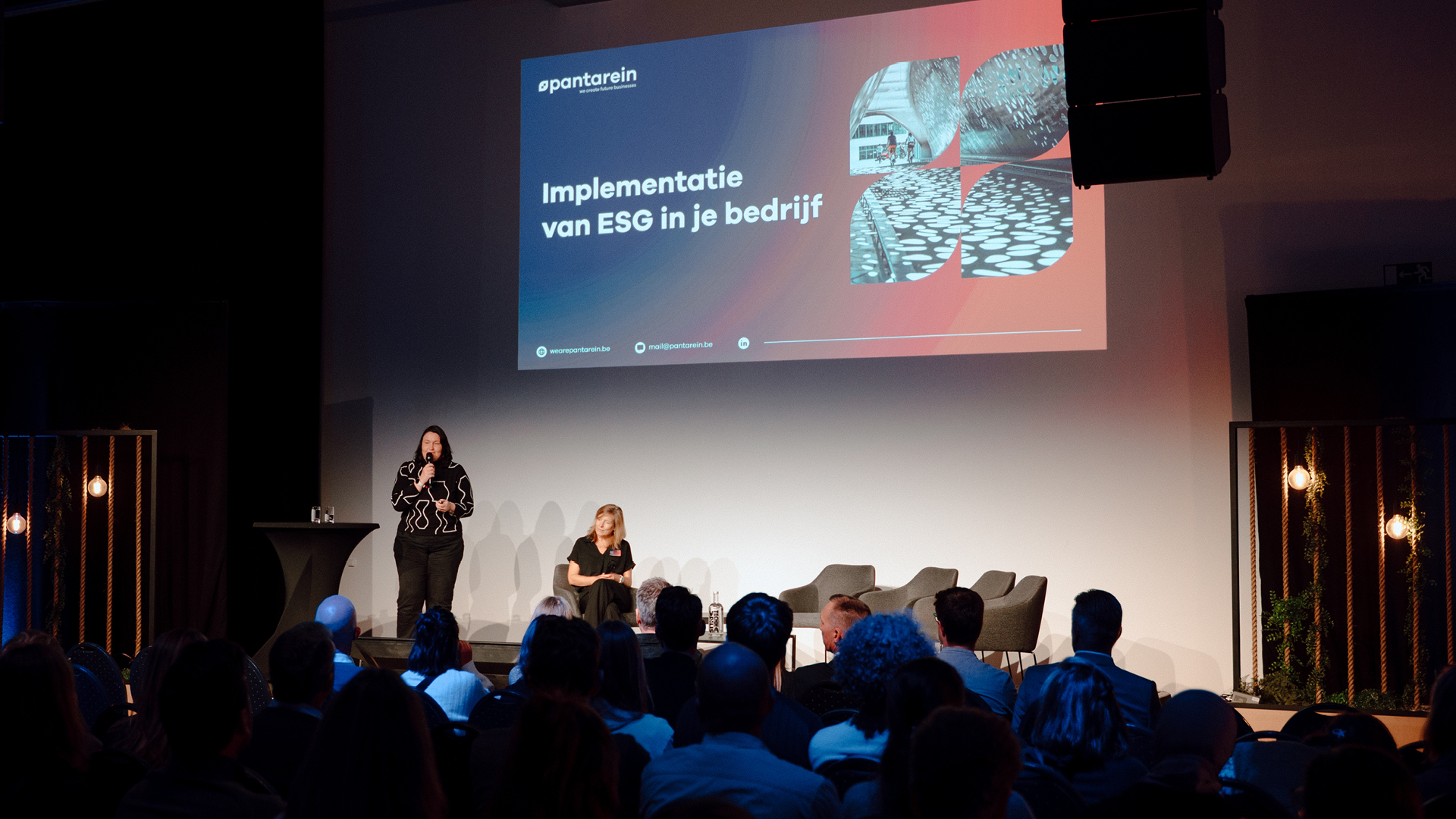
This Insight is based on the panel discussion 'Implementing ESG in your business operations' during the fourth Pantarein event, on Tuesday 14 October 2025 at Technopolis, Mechelen.

Implementing ESG step by step?

Pantarein guides you in turning your ESG goals into concrete results, strengthening trust among your stakeholders, and developing a future-proof business model. Request a no-obligation consultation with our experts via mail@pantarein.be.